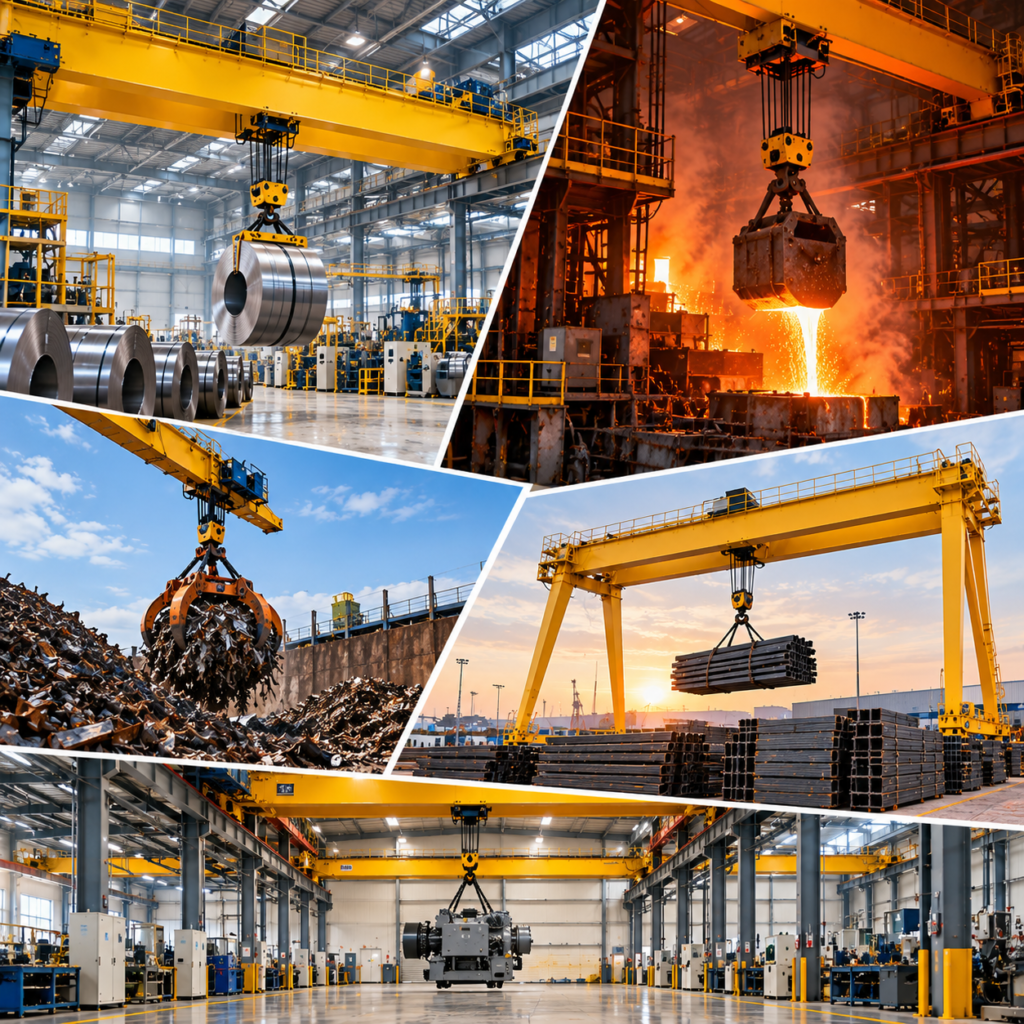
An industrial crane is not designed only around the weight it needs to lift. The environment where the crane will operate can have an equally important role in determining its configuration, components and operating requirements.
A crane working inside a controlled manufacturing area may face very different conditions from one used around a furnace, in a scrapyard, inside a dusty production facility or in an area with limited headroom.
This is why industrial crane suppliers need to understand the complete working environment before finalizing a crane design.
The load, operating frequency, available space, temperature, material being handled and site conditions all need to be considered together.
For industrial buyers, understanding this process can make it easier to specify equipment that fits the actual application instead of selecting a crane based only on capacity or crane type.
Why the Working Environment Matters in Crane Design
Two cranes with similar lifting capacities may still require different designs when they operate in different environments.
For example, a crane used for routine lifting in a workshop may primarily need to match the required load, span, lifting height and operating cycle.
A crane operating near a furnace may need to account for high temperatures. Equipment handling scrap may require a different lifting arrangement. A facility with restricted overhead space may need a crane configuration designed around its structural limitations.
The working environment can influence:
- Crane configuration
- Lifting equipment
- Operating speed
- Control system
- Structural requirements
- Protection requirements
- Installation arrangement
- Maintenance access
- Material handling method
SWIFT states that its industrial cranes are custom-built according to operational requirements, with flexibility in span, lifting capacity and speed.
This application-focused approach is important because the right crane is not simply the one with sufficient lifting capacity. It is the one that fits the complete operating requirement.
What Does an Industrial Crane Supplier Need to Understand?
Before designing or recommending a crane, the supplier needs a clear picture of the application.
A useful starting point is to evaluate five areas:
- Where will the crane operate?
- What will it lift?
- How frequently will it operate?
- How much space is available?
- What environmental conditions can affect operation?
These questions provide the foundation for selecting the crane configuration and developing the technical specifications.
1. Start With the Working Environment
The first step in crane design is understanding the location where the equipment will operate.
The supplier may need to determine whether the crane will be used:
- Inside a manufacturing facility
- In a warehouse
- Outdoors
- Near a furnace
- In a scrapyard
- In a maintenance area
- In a dusty production environment
- In a hazardous area
- In a restricted-headroom location
Each environment can introduce different design considerations.
For example, SWIFT’s industry applications include furnace maintenance, scrapyard operations, finished goods handling, conveyor and elevator drive maintenance, and crane maintenance within the metal industry.
This demonstrates why the same crane arrangement should not automatically be applied to every area of a facility.
2. Identify the Material Being Handled
The material being lifted is another important part of crane design.
Industrial cranes may be required to handle:
- General industrial loads
- Heavy machinery
- Steel products
- Ferrous materials
- Scrap
- Bulk materials
- Maintenance components
- Production equipment
The lifting method should correspond to the material and application.
Ferrous Material Handling
Magnet cranes are designed for handling ferrous materials. SWIFT offers magnet cranes as part of its industrial crane range.
Scrap and Bulk Material Handling
Grabbing cranes can be used for bulk material handling applications. SWIFT states that its grabbing cranes can be customized according to the load and working environment.
General Industrial Loads
EOT cranes can be considered for overhead material handling applications where the building arrangement and operating requirements are suitable.
The important point is that the material should be identified before selecting the lifting arrangement.
3. Consider the Operating Cycle
The number of times a crane operates can affect how the equipment needs to be configured.
A crane used occasionally for maintenance may have a different operating requirement from one that forms part of a regular production process.
The supplier should understand:
- How often the crane will operate
- Typical loads
- Maximum loads
- Working hours
- Required lifting speed
- Travel distance
- Positioning requirements
- Frequency of starting and stopping
This information helps establish the operating requirements for the crane.
SWIFT identifies factors such as load capacity, span, lift height, duty cycle and available workspace as important considerations when selecting a crane.
4. Design Around High-Temperature Environments
High-temperature areas require particular attention during equipment selection.
This is especially relevant to metal and manufacturing facilities where cranes or hoists may operate close to furnaces or other heat-producing equipment.
The supplier should understand:
- Where the heat source is located
- How close the equipment will operate to it
- How frequently lifting will take place
- What materials will be handled
- What equipment protection is required
- Whether specialized lifting equipment is appropriate
SWIFT’s metal industry applications include furnace maintenance, where its flame-proof hoists are intended for high-temperature environments.
The important consideration is not simply labeling an application as “high temperature.” The actual site conditions should be understood before the equipment is specified.
5. Account for Dusty Industrial Environments
Dust can be present in many industrial environments and may become an important consideration when selecting lifting equipment.
Examples include:
- Scrap handling areas
- Foundry environments
- Cement facilities
- Mining-related applications
- Material storage areas
- Manufacturing operations
The supplier should understand the type of environment and how the crane will be exposed to it.
SWIFT identifies foundry applications as environments that can involve high-temperature and dusty conditions, while its metal industry solutions include specialized equipment for scrapyard and material handling operations.
The crane design should therefore be considered in relation to the actual operating conditions rather than treating all industrial environments as identical.
6. Consider Outdoor Operating Conditions
Outdoor crane applications introduce conditions that may not exist inside a controlled facility.
The design process may need to account for:
- Weather exposure
- Moisture
- Wind
- Temperature changes
- Corrosive conditions
- Outdoor travel paths
- Installation conditions
- Maintenance access
The surrounding infrastructure also becomes important.
The supplier needs to understand how the crane will be supported, where it will travel and how operators will access the equipment for inspection and maintenance.
7. Design for Humid or Corrosive Environments
Moisture and corrosive conditions can create additional requirements for industrial lifting equipment.
The supplier should understand factors such as:
- Humidity
- Moisture exposure
- Chemical exposure
- Cleaning processes
- Operating location
- Maintenance requirements
SWIFT’s industry information includes applications involving moisture-heavy environments and corrosive conditions, with corrosion-resistant equipment identified for certain sectors.
Rather than choosing equipment based on a general environmental label, the actual conditions at the installation site should be evaluated.
8. Work Around Limited Headroom
Not every industrial building has enough overhead space for a conventional crane arrangement.
Limited headroom can affect:
- Hook height
- Hoist position
- Crane configuration
- Load movement
- Maintenance access
- Available lifting height
In such applications, an underslung EOT crane may be considered where ceiling height or structural limitations prevent the installation of a standard overhead crane.
SWIFT offers single girder underslung EOT cranes for applications involving ceiling height or structural limitations.
The important point is that available headroom should be considered early in the design process rather than after the crane configuration has already been finalized.
9. Match the Crane Configuration to the Application
Once the environment, load and operating conditions are understood, the supplier can evaluate the appropriate crane configuration.
SWIFT’s industrial crane range includes:
- Single Girder EOT Cranes
- Double Girder EOT Cranes
- Magnet Cranes
- Jib Cranes
- Gantry Cranes
- Hand Operated Travelling Cranes
- Semi Gantry Cranes
- Grabbing Cranes
- Single Girder Underslung EOT Cranes
Each configuration has a different application context.
EOT Cranes
EOT cranes can provide overhead material handling across industrial work areas where the building and operating conditions support an overhead runway arrangement.
Magnet Cranes
Magnet cranes are intended for ferrous material handling applications.
Grabbing Cranes
Grabbing cranes can support bulk material handling requirements where a grab attachment is appropriate.
Jib Cranes
Jib cranes are suited to localized lifting requirements such as workstations, assembly areas and maintenance locations.
Gantry and Semi Gantry Cranes
These configurations can be considered where the site arrangement and structural requirements make them appropriate.
Underslung EOT Cranes
Underslung cranes can be considered when structural or headroom limitations affect conventional overhead crane installation.
The correct configuration should always be selected according to the actual application.
10. Consider Span, Lift Height and Available Workspace
The crane needs to operate within the physical limits of the facility.
Important measurements can include:
- Required span
- Lifting height
- Available headroom
- Travel distance
- Building dimensions
- Existing structures
- Columns and obstructions
- Maintenance access
A crane with the correct lifting capacity may still be unsuitable if its physical configuration does not work with the building.
SWIFT states that its cranes can be customized in areas including span, lifting capacity, speed and control systems according to application requirements.
This is why site measurements and layout information should be part of the initial crane enquiry.
11. Choose Controls and Operating Speed According to the Application
Control requirements can vary depending on the type of material handling operation.
Some applications may require precise positioning, while others may prioritize movement across a larger working area.
The supplier should consider:
- Hoisting speed
- Travel speed
- Positioning requirements
- Control system
- Operator requirements
- Frequency of operation
SWIFT specifically identifies speed and control systems among the areas where its cranes can be customized according to application requirements.
The goal is to select controls and operating characteristics that support the actual workflow.
12. Consider the Supporting Structure
Crane design cannot be separated from the building or support structure.
Before finalizing the equipment, the supplier may need information about:
- Existing runway arrangements
- Building structure
- Supporting columns
- Available headroom
- Installation access
- Travel path
- Structural limitations
This becomes especially important when installing equipment in an existing facility.
For facilities with structural restrictions, an alternative configuration may provide a better fit than trying to force a conventional arrangement into the available space.
13. Engineering and Customization Should Follow the Application
Industrial facilities rarely have identical requirements.
Even facilities operating within the same industry can have different:
- Building layouts
- Load requirements
- Working environments
- Operating cycles
- Headroom limitations
- Material handling processes
- Maintenance requirements
For this reason, customization can be useful when a standard configuration does not fully match the application.
SWIFT describes its industrial cranes as custom-built to suit operational requirements, with flexibility in span, lifting capacity and speed.
Customization should have a clear purpose. It should address the actual requirements of the application rather than adding unnecessary specifications.
14. Quality Testing Is Part of the Design Process
Crane design does not end when the configuration is selected.
Manufacturing and testing are also important parts of delivering equipment for industrial use.
SWIFT states that its industrial cranes are designed according to IS 3177, IS 807 and IS 4137. The company also states that its cranes undergo quality checks including ultrasonic testing, dye penetrant testing and magnetic particle testing.
SWIFT further states that every crane is tested for 25% overload, deflection and speed.
These documented processes provide buyers with useful information when evaluating how a crane is manufactured and tested.
Working Environment and Crane Design at a Glance
| Working Environment | Key Design Considerations |
|---|---|
| General manufacturing | Load, span, lift height and duty cycle |
| High-temperature area | Heat exposure and application-specific equipment |
| Furnace area | Temperature and specialized maintenance requirements |
| Scrapyard | Material type and handling method |
| Dusty environment | Operating conditions and equipment suitability |
| Outdoor area | Weather and site conditions |
| Humid environment | Moisture and corrosion considerations |
| Restricted headroom | Hook height and crane configuration |
| Maintenance area | Access, positioning and lifting requirements |
| Bulk material area | Load type and suitable lifting attachment |
This comparison shows why crane design needs to start with the environment and application rather than the product name alone.
What Information Should You Provide to an Industrial Crane Supplier?
A supplier can develop a more suitable solution when the application information is clearly defined.
Before requesting a crane quotation, prepare the following details.
Load Information
- Maximum load
- Typical load
- Type of material
- Lifting accessories
- Load dimensions
Site Information
- Building dimensions
- Required span
- Required lifting height
- Available headroom
- Existing structures
- Obstructions
Operating Information
- Working hours
- Lifting frequency
- Travel distance
- Required speeds
- Positioning requirements
Environmental Information
- Indoor or outdoor operation
- Temperature
- Dust
- Moisture
- Chemical exposure
- Furnace or heat exposure
Installation Information
- Existing runway
- Supporting structure
- Available installation access
- Power requirements
- Maintenance access
Providing these details at the beginning can help the supplier understand the application more accurately.
How to Evaluate an Industrial Crane Supplier
When comparing industrial crane suppliers, price should not be the only consideration.
Look at whether the supplier can address the complete application.
Consider:
- Understanding of the working environment
- Crane configuration options
- Engineering capability
- Customization
- Manufacturing processes
- Quality testing
- Installation requirements
- Spare parts
- Service support
SWIFT states that genuine spare parts and service support are available through its service network.
This is particularly relevant for industrial buyers looking beyond the initial purchase and considering the equipment’s ongoing support requirements.
SWIFT Industrial Crane Solutions for Different Environments
Consolidated SWIFT Industries Limited provides industrial cranes and hoisting solutions for different material handling applications.
Its industrial crane range includes EOT cranes, magnet cranes, grabbing cranes, jib cranes, gantry cranes, semi gantry cranes and underslung EOT cranes.
SWIFT also supports applications across industries including manufacturing, engineering, metal, cement, logistics, railways, power plants and other industrial sectors.
Its metal industry applications include conveyor and elevator drive maintenance, scrapyard operations, finished goods handling, crane maintenance and furnace applications.
For industrial crane buyers, this application-based approach helps connect the equipment configuration with the actual environment where it will operate.
Design the Crane Around the Environment
The working environment is one of the most important factors in industrial crane design.
A crane operating in a general manufacturing area does not necessarily face the same requirements as equipment working near a furnace, handling scrap, operating outdoors or working within restricted headroom.
The design process should therefore consider the environment, load, operating cycle, site layout and material handling process together.
When these factors are clearly defined, the industrial crane supplier can develop a configuration that is better aligned with the facility’s actual requirements.
Need an Industrial Crane for Your Working Environment?
Discuss your load requirements, site conditions and operating environment with SWIFT to explore a crane configuration suited to your application.