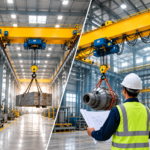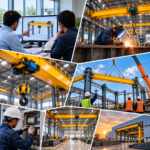

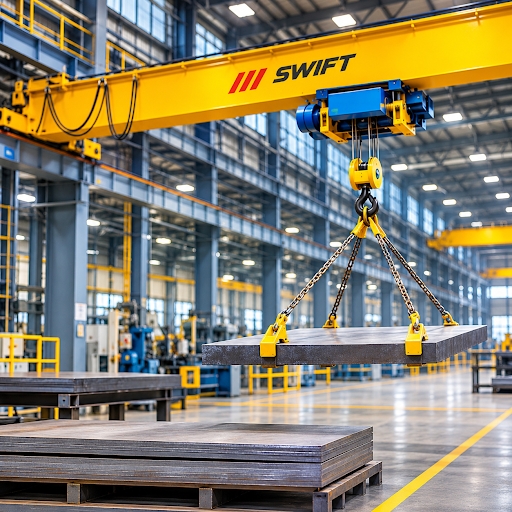
In industrial environments, productivity depends on more than machinery and manpower. The way materials move across a factory floor can have a significant impact on production schedules, operational efficiency and workplace safety. When heavy materials need to be lifted, transported and positioned regularly, an Electric Overhead Travelling (EOT) crane becomes an important part of the production process.
However, simply installing an EOT crane does not automatically guarantee better productivity. Its design must match the facility’s layout, lifting requirements, operating conditions and material-handling workflow.
An appropriately designed EOT crane can help reduce unnecessary material movement, improve workspace utilisation, support accurate load positioning and minimise avoidable operational interruptions.
At Consolidated SWIFT Industries Limited (CSIL), industrial crane solutions are developed around different material-handling requirements. Understanding the relationship between EOT crane design and workplace productivity can help businesses make more informed decisions when planning their lifting systems.
Why Does EOT Crane Design Matter in Industrial Workplaces?
Every industrial facility has different operational requirements. A manufacturing plant handling heavy steel components may have different lifting needs from an engineering workshop or an assembly facility.
If a crane is not designed according to the actual working environment, employees may face unnecessary material transfers, restricted movement, inefficient load positioning and delays during production.
For example, a crane with unsuitable travel coverage may require additional handling equipment to move materials between workstations. Similarly, insufficient lifting height can make it difficult to position loads around machinery or other structures.
A well-planned EOT crane design considers these operational challenges before installation. It aims to provide suitable lifting coverage, movement, capacity and control for the tasks the equipment is expected to perform.
The result is a material-handling system that supports the wider production process instead of becoming a limitation within it.
6 EOT Crane Design Factors That Influence Workplace Productivity
Several engineering and operational factors determine how effectively an EOT crane performs in a workplace. These factors should be evaluated together rather than considered separately.
1. Load Capacity and Material Requirements
Load capacity is one of the first considerations in EOT crane design. The crane must be suitable for the weight and nature of the materials handled during regular operations.
Undersizing the lifting system can restrict its use and create operational limitations. On the other hand, selecting a capacity without considering the actual application may result in an unnecessarily large or unsuitable system.
Before finalising the design, businesses should evaluate:
- The maximum weight of the materials being lifted.
- The typical load handled during regular operations.
- The dimensions and shape of the materials.
- The frequency of lifting activities.
- Any special lifting attachments required for the application.
Matching the crane capacity to actual material-handling requirements helps businesses plan lifting operations more effectively and supports safe, consistent performance.
2. Crane Span and Workspace Coverage
Crane span determines the horizontal distance the crane needs to cover between its runway supports. It directly influences how materials can be moved across the working area.
In a manufacturing facility, materials may need to travel between storage locations, production machines, assembly stations and dispatch areas.
If the crane coverage does not match the facility layout, operators may need additional handling arrangements to complete certain movements. This can introduce extra steps into the workflow.
During the design stage, the available building dimensions, runway arrangement, machine locations and required load movement paths should be considered.
The objective is to provide appropriate coverage for the intended working area while accounting for structural and operational requirements.
3. Lifting Height and Available Headroom
Vertical space is just as important as horizontal coverage.
Lifting height determines how far a crane can raise a load, while headroom relates to the available space between the building structure and the crane’s lifting arrangement.
In facilities with limited ceiling height, machinery, overhead services or structural restrictions can affect the crane configuration.
An unsuitable design may restrict the movement of loads or reduce the usable lifting height. This can make certain material-handling activities more difficult.
Where conventional overhead crane arrangements are restricted by building conditions, an alternative configuration may need to be considered.
For example, the SWIFT Single Girder Underslung E.O.T. Crane is designed for applications where ceiling height or structural limitations make standard overhead crane installation difficult. Its bottom-running arrangement allows it to operate on the bottom flange of runway beams.
The configuration is available with safe working loads from 0.5 to 40 tonnes and spans up to 30 metres, subject to the application and design requirements.
Read more about the SWIFT Single Girder Underslung EOT Crane.
4. Hoisting and Travel Speeds
An EOT crane performs several movements during a lifting operation:
- Hoisting: Raising and lowering the load.
- Cross travel: Moving the trolley across the crane bridge.
- Long travel: Moving the crane along the runway.
The speed selected for each movement can influence the time required to complete material-handling tasks.
For example, repetitive lifting operations across a large production area may require different movement characteristics from precision positioning near machinery or assembly stations.
Higher speed is not always the best solution. The movement must remain appropriate for the load, working environment and required positioning accuracy.
A suitable combination of hoisting, cross-travel and long-travel speeds can help balance operational efficiency with controlled load movement.
5. Control Systems and Load Positioning
The control system influences how operators manage crane movements and position materials.
When loads need to be placed accurately near machinery, workstations or storage locations, controlled movement becomes particularly important.
The design should consider the operating environment, visibility, operator access and the level of positioning control required.
Depending on the application, suitable control arrangements and optional features may help operators manage lifting activities more effectively.
For facilities with repetitive material-handling tasks, well-planned controls can support consistent operation and reduce unnecessary adjustments during load positioning.
6. Duty Requirements and Operating Environment
Not every EOT crane operates under the same conditions. Some facilities require occasional lifting, while others perform frequent or demanding material-handling operations throughout their production schedules.
This is why duty requirements should be considered during crane selection and design.
The design process should evaluate:
- Frequency of lifting operations.
- Average operating hours.
- Load characteristics.
- Working environment and temperature conditions.
- Required movement cycles.
- Maintenance and inspection requirements.
Selecting a crane according to its intended operating conditions helps ensure that the equipment is suitable for the work it needs to perform.
How EOT Crane Design Supports Different Industrial Workflows
The impact of crane design becomes clearer when it is considered in the context of actual industrial applications.
Manufacturing and Assembly Lines
Manufacturing facilities often require materials and components to move between multiple workstations.
An appropriately designed EOT crane can support these movements by providing suitable lifting coverage and positioning capabilities. This helps integrate material handling into the production workflow.
Steel and Metal Industries
Steel and metal processing facilities frequently handle heavy materials, fabricated components and large workpieces.
Crane design must account for load characteristics, lifting requirements, working conditions and the movement paths needed within the facility.
For specialised material handling, the appropriate crane configuration and lifting arrangement should be selected according to the application.
Engineering and Fabrication Workshops
Engineering workshops may handle components of different dimensions and weights. Material movement often takes place between fabrication, machining, assembly and inspection areas.
The right crane layout can help provide access to the required work zones and reduce unnecessary handling steps.
Warehousing and Industrial Storage
In storage facilities, lifting equipment may be used to move materials between designated storage and handling areas.
The crane’s span, lifting height and operating coverage should reflect the facility layout and the way materials are received, stored and dispatched.
Choosing the Right EOT Crane Configuration for Your Workspace
EOT crane configuration should be selected according to the facility’s structural conditions, lifting requirements and operational workflow.
Single Girder EOT Crane
A single girder EOT crane may be suitable for applications where its capacity and structural arrangement meet the facility’s lifting requirements.
The design should consider the required span, lifting height, operating conditions and available building structure.
Double Girder EOT Crane
Double girder EOT cranes may be considered for applications requiring different structural and lifting arrangements, including demanding industrial material-handling operations.
The selection should be based on the actual load, operating conditions, required lifting height and facility layout.
Single Girder Underslung EOT Crane
An underslung arrangement can be useful where conventional overhead crane installation is restricted by available headroom or structural conditions.
The appropriate configuration depends on the building structure, runway arrangement and intended lifting application.
The most suitable option is not necessarily the largest crane. It is the configuration that meets the operational requirement while fitting the available workspace.
How the Right Crane Design Helps Reduce Operational Downtime
Operational interruptions can affect production schedules, material availability and overall plant performance.
While crane design alone cannot eliminate every cause of downtime, appropriate planning can help reduce avoidable material-handling difficulties.
For example, a crane designed with suitable coverage can support material movement across the intended working area. Appropriate movement speeds can help operators complete lifting cycles without compromising control. Suitable equipment selection and maintenance planning can also support consistent operation.
Businesses should consider the following points:
- Application-based design: Match the crane to the actual lifting and movement requirements.
- Suitable operating conditions: Select equipment according to the expected frequency and nature of use.
- Maintenance accessibility: Consider how inspections and servicing will be carried out.
- Appropriate safety provisions: Include suitable protective features according to the application.
- Correct installation planning: Ensure that the crane and supporting structure are suitable for the intended arrangement.
These considerations can help create a more dependable material-handling process and reduce disruptions caused by unsuitable equipment planning.
The Role of Safety and Precision in Workplace Productivity
Workplace safety and productivity are closely connected. Uncontrolled load movement, unsuitable lifting practices and inadequate equipment planning can create risks for workers and disrupt operations.
An effective EOT crane design should account for the safety requirements of the application from the beginning.
Depending on the crane configuration and operating conditions, relevant provisions may include limit switches, emergency upper limit switches, suitable braking arrangements, load-related protection and appropriate control systems.
Operator training, regular inspections and preventive maintenance are also essential parts of safe crane operation.
At CSIL, crane design and manufacturing are aligned with applicable engineering standards, including IS 3177, IS 807 and IS 4137, as stated in the company’s crane range information. Each crane is also tested for overload, deflection and speed as part of its stated testing process.
A combination of suitable design, correct operation and ongoing maintenance helps support safer and more consistent material handling.
How Consolidated SWIFT Industries Limited Supports Industrial Crane Requirements
Different industries require different lifting arrangements. A crane designed for one facility may not be suitable for another because building dimensions, material characteristics, lifting frequency and production processes can vary significantly.
Consolidated SWIFT Industries Limited (CSIL) provides industrial material-handling solutions designed around application requirements.
Its crane range includes:
- Single Girder EOT Cranes.
- Double Girder EOT Cranes.
- Single Girder Underslung EOT Cranes.
- Jib Cranes.
- Gantry Cranes.
- Semi-Gantry Cranes.
- Magnet Cranes.
- Grabbing Cranes.
SWIFT states that crane solutions can be customised according to requirements such as span, lifting capacity, speed and control systems.
With a legacy dating back to 1966 and more than 30,000 installations stated on its website, CSIL brings extensive material-handling experience to industrial applications.
Explore the complete SWIFT crane range to understand the available solutions.
You can also learn more about the industries served by Consolidated SWIFT Industries Limited.
Frequently Asked Questions
1. How does EOT crane design impact workplace productivity?
EOT crane design affects material movement, lifting coverage, load positioning and workflow efficiency. A crane designed according to the facility’s requirements can help reduce unnecessary handling steps and support smoother industrial operations.
2. What factors should be considered when designing an EOT crane?
Important factors include safe working load, span, lifting height, available headroom, hoisting and travel speeds, duty requirements, control systems and the building’s structural conditions.
3. How does crane span influence productivity?
Crane span determines the horizontal area the equipment can cover. Appropriate span selection helps ensure that the crane can reach the required working zones and support the intended material-handling process.
4. Which EOT crane configuration is suitable for manufacturing facilities?
The suitable configuration depends on the lifting capacity, facility layout, building structure, operating frequency and material-handling requirements. Single girder, double girder and underslung arrangements may be considered according to the application.
5. Why is lifting height important in EOT crane design?
Lifting height determines the vertical distance available for raising and positioning loads. It should be planned according to the materials handled, machinery layout, building clearance and required movement paths.
6. Can EOT cranes be customised according to industrial requirements?
Yes. Crane configurations can be planned according to application-specific requirements such as lifting capacity, span, speed, control systems and operating conditions. The final design should be based on technical evaluation of the facility.
Conclusion
EOT crane design plays an important role in how efficiently materials move through an industrial workplace. Factors such as lifting capacity, span, headroom, movement speed, control systems and operating conditions all influence the equipment’s suitability for a particular application.
Rather than selecting a crane based on capacity alone, businesses should consider the complete production environment and the way materials need to move within it.
With application-focused engineering and a range of industrial lifting solutions, Consolidated SWIFT Industries Limited supports businesses in identifying crane arrangements that align with their material-handling requirements.
Looking to improve material handling in your facility? Connect with the SWIFT team to discuss your crane requirements.