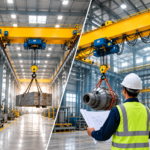

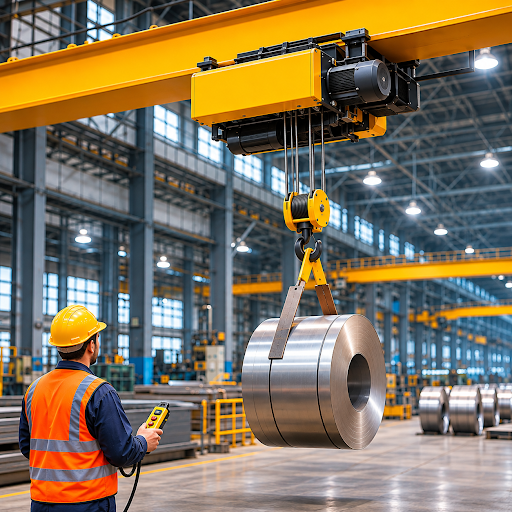
Steel and manufacturing plants handle some of the most demanding material movement operations in the industrial sector. From lifting heavy steel components and fabricated structures to positioning machinery and transferring finished products, every lifting operation requires equipment that delivers strength, precision and reliability.
Handling these loads efficiently is essential for maintaining production schedules, minimising material handling delays and supporting safer workplace operations.
This is where wire rope hoists play an important role.
Designed for a wide range of industrial lifting requirements, electric wire rope hoists help move heavy loads through controlled and reliable lifting mechanisms. When integrated with suitable crane systems, they support material handling across production facilities, fabrication workshops, steel plants and manufacturing units.
At Consolidated SWIFT Industries Limited, we offer a comprehensive range of wire rope hoists engineered for different industrial applications. With multiple configurations, lifting capacities and customisation options, SWIFT solutions help businesses address their specific material handling requirements.
Why Steel and Manufacturing Plants Need Reliable Lifting Equipment
Steel and manufacturing facilities involve continuous movement of raw materials, machinery, equipment and finished products. Many of these materials are too heavy or difficult to move using conventional handling methods.
A suitable lifting system helps streamline these operations while supporting workplace safety and production efficiency.
Some common challenges include:
- Heavy material movement: Steel sections, fabricated structures and machinery require lifting equipment selected according to their weight and dimensions.
- Frequent lifting operations: Repeated lifting cycles demand equipment designed for the required duty classification and operating conditions.
- Space limitations: Production facilities may have restricted overhead clearance, making hoist dimensions and mounting configurations important.
- Precise load positioning: Machinery installation and component handling require controlled lifting and positioning.
- Demanding working environments: Dust, heat, humidity and other site conditions influence equipment selection and protection requirements.
Choosing suitable industrial wire rope hoists helps manufacturing facilities address these challenges with a more organised and efficient lifting arrangement.
Key Applications of Wire Rope Hoists in Steel and Manufacturing Plants
Wire rope hoists support several material handling activities across industrial facilities. Their applications depend on load characteristics, crane arrangements, lifting capacity and operating requirements.
1. Handling Heavy Steel Components
Steel manufacturing involves moving materials such as fabricated sections, structural components, metal assemblies and other heavy products.
These materials often require controlled lifting during production, storage and transportation within the facility.
Wire rope hoists integrated with suitable overhead crane systems can help move these loads between designated workstations while supporting organised production workflows.
The lifting arrangement should be selected according to the load weight, dimensions, lifting points and required movement.
2. Moving Raw Materials and Finished Products
Manufacturing facilities regularly transfer raw materials and finished products between different operational areas.
Wire rope hoists can support these activities by lifting and positioning materials during loading, unloading and internal transportation.
For example, steel components may need to be moved from a storage section to a fabrication area before further processing. Similarly, completed assemblies may need to be transferred to dispatch or storage sections.
Selecting the right lifting configuration helps make these movements more efficient.
3. Supporting Machinery Installation and Maintenance
Industrial production equipment often consists of heavy components that require careful lifting during installation, inspection or replacement.
Motors, gearboxes and other machinery components may need to be repositioned during planned maintenance activities.
A properly configured wire rope hoist can support these operations by providing controlled lifting and accurate positioning.
This is particularly useful in manufacturing facilities where equipment maintenance is an important part of operational continuity.
4. Supporting Fabrication and Assembly Operations
Fabrication workshops handle large metal sections and assemblies throughout different stages of production.
Moving these components manually can create operational difficulties, especially when dealing with heavy or oversized materials.
Wire rope hoists installed on suitable crane systems help transfer components between workstations and support lifting activities during assembly and fabrication.
The appropriate hoist capacity and configuration depend on the size of the components and the required lifting cycle.
5. Heavy-Duty Material Handling in Large Industrial Facilities
Large manufacturing facilities and steel plants may require lifting systems with higher capacities and extended lifting heights.
Standard hoist arrangements may not always meet these requirements.
In such situations, specialised configurations such as open winch wire rope hoists can be considered.
These systems provide flexibility for applications that demand higher lifting capacities, customised arrangements and greater lifting heights.
Choosing the Right Wire Rope Hoist Configuration for Industrial Applications
Different industrial facilities have different lifting requirements. A compact manufacturing workshop may need a different arrangement from a large steel plant handling substantial loads.
Understanding the available SWIFT configurations helps businesses identify suitable solutions.
1. SWIFT SWF Wire Rope Hoist
The SWIFT SWF Wire Rope Hoist range is designed for diverse industrial lifting requirements.
Available configurations accommodate capacities from 0.25 to 15 tonnes in standard and higher-lift models, with specialised open winch configurations available for heavier applications.
Key features include:
- High-torque induction motor.
- Hardened steel gear system.
- Smooth wire rope winding mechanism.
- Fail-safe braking system.
- VFD options for micro-speed hoisting.
- Customisation options for different lifting requirements.
These features support reliable lifting operations across manufacturing and other industrial environments.
2. FLINT Wire Rope Hoist
The FLINT Wire Rope Hoist is designed for single-girder, box-type electrically operated cranes.
Its compact construction and optimised drum and reeving arrangement help reduce headroom and side clearances.
Key specifications include:
- Lifting capacities from 1 to 10 tonnes.
- Lifting heights of 6, 9 and 12 metres.
- Compact and lightweight construction.
- Fail-safe braking system.
- Overload protection and limit switches.
- Pendant or remote control options.
FLINT is particularly relevant to manufacturing workshops, assembly lines and process plants where available installation space is an important consideration.
3. KINDLE Wire Rope Hoist
The SWIFT KINDLE Wire Rope Hoist is engineered for controlled and reliable lifting across different industrial material handling applications.
It can be integrated with suitable EOT cranes, gantry cranes, jib cranes and monorail systems.
Key features include:
- Capacities from 1 to 10 tonnes for monorail applications.
- Capacities up to 16 tonnes for double-girder configurations.
- VFD-powered dual-speed lifting.
- Compact low-headroom design.
- Optimised reeving arrangement for improved load stability.
- Dual safety mechanisms.
Its controlled lifting capabilities make it suitable for applications where accurate load positioning and smooth movement are important.
4. Open Winch Wire Rope Hoist
For demanding industrial lifting requirements, SWIFT Open Winch Wire Rope Hoists provide customised configurations for larger loads and extended lifting heights.
Key specifications and features include:
- Lifting capacities from 1 to 40 tonnes.
- Lifting heights up to 75 metres.
- Customised plate-type and frame-type configurations.
- Variable-speed options.
- Flame-proof construction options.
- Compatibility with suitable single-girder and double-girder crane arrangements.
These configurations are particularly relevant to large industrial installations requiring higher lifting capacities and specialised equipment arrangements.
Important Factors to Consider When Selecting Wire Rope Hoists
Selecting a wire rope hoist involves more than checking its maximum lifting capacity. Several technical and operational factors determine whether a particular configuration is suitable for a steel or manufacturing facility.
1. Load Capacity
The hoist must be selected according to the maximum intended load, including the weight of lifting attachments where applicable.
Understanding the actual load requirements helps avoid selecting equipment that is unsuitable for the application.
2. Lifting Height
The required vertical lifting distance influences the hoist configuration, wire rope arrangement and installation requirements.
Facilities with greater lifting-height requirements may need specialised configurations such as open winch hoists.
3. Duty Classification
Duty classification is important for equipment operating under frequent or demanding lifting cycles.
The expected operating frequency, load spectrum and working duration should be evaluated before selecting the appropriate hoist.
4. Lifting Speed and Load Control
Different industrial operations require different lifting speeds.
For example, transferring materials across a production floor may require different movement characteristics from positioning a heavy component during machinery installation.
VFD technology allows controlled speed adjustment and smoother lifting operations.
5. Available Installation Space
The available overhead clearance and supporting crane structure influence the selection of hoist configuration.
Compact and low-headroom designs can be useful where maximising available lifting height is important.
6. Operating Environment
Dust, heat, humidity and potentially hazardous conditions can affect equipment selection.
Suitable protective finishes, electrical protection and specialised configurations should be considered according to the actual site conditions.
7. Crane Compatibility
The hoist must be compatible with the supporting crane or lifting structure.
Compatibility with single-girder cranes, double-girder cranes, monorails and other suitable arrangements should be evaluated during system design.
How VFD Technology Improves Industrial Lifting Operations
Precision is an important part of heavy-duty material handling.
When lifting heavy steel components or positioning industrial machinery, sudden movement can make load handling more difficult. Controlled acceleration and speed adjustment help operators manage lifting operations more effectively.
Variable Frequency Drive (VFD) technology allows lifting speed to be adjusted according to operational requirements.
Some important advantages include:
- Smoother acceleration and deceleration.
- Better control during load positioning.
- Reduced sudden movement during lifting.
- Improved handling during precision operations.
- Greater flexibility across different lifting tasks.
SWIFT offers VFD-based lifting options, including dual-speed operation in the KINDLE Wire Rope Hoist, supporting applications where controlled lifting movement is important.
Safety Considerations for High-Capacity Lifting Operations
Safety should remain a priority whenever heavy materials are lifted in industrial facilities.
A properly selected hoist must be supported by suitable installation, inspection and operating procedures.
Important considerations include:
Overload Protection: Suitable protection helps prevent lifting beyond the rated capacity of the equipment.
Braking Systems: Reliable braking arrangements are essential for controlling and holding suspended loads.
Limit Switches: Appropriate lifting and travel limits help prevent movement beyond designated operating ranges.
Wire Rope Inspection: Regular inspection helps identify wear, corrosion, deformation and other conditions that may affect rope performance.
Operator Training: Operators should understand equipment controls, rated capacities, safe lifting practices and emergency procedures.
Preventive Maintenance: Scheduled maintenance helps identify potential issues before they lead to unexpected equipment downtime.
All lifting activities should follow the manufacturer’s instructions and applicable industrial safety requirements.
Why Choose Consolidated SWIFT Wire Rope Hoists?
At Consolidated SWIFT Industries Limited, we understand that industrial lifting requirements vary according to the facility, load characteristics and operating environment.
Our wire rope hoist range is designed to support diverse material handling requirements, from standard industrial operations to demanding heavy-duty applications.
Key advantages of the SWIFT range include:
- Wide Capacity Range: Wire rope hoists available from 0.25 to 40 tonnes across different configurations.
- Extended Lifting Heights: Selected configurations offer lifting heights of up to 75 metres.
- Multiple Product Configurations: Standard, low-headroom, flame-proof, open winch and bi-rail crab options.
- Controlled Lifting: VFD options for micro-speed and dual-speed operation.
- Safety Features: Fail-safe braking systems and suitable overload and control protection options.
- Application Flexibility: Solutions for manufacturing, steel, metal processing, engineering and other industrial sectors.
Our focus is on providing dependable lifting solutions that support industrial productivity, operational safety and long-term equipment performance.
Frequently Asked Questions About Wire Rope Hoists
1. What are wire rope hoists used for in steel plants?
Wire rope hoists are used for lifting and positioning heavy materials, machinery and industrial components. In steel plants, they can support material movement, finished goods handling, equipment installation and maintenance activities.
2. What capacity of wire rope hoist is suitable for steel manufacturing?
The required capacity depends on the maximum load, lifting attachments, operating frequency and application. SWIFT offers wire rope hoists across a range of configurations, with overall capacities from 0.25 to 40 tonnes.
3. Are wire rope hoists suitable for heavy-duty industrial operations?
Yes. Appropriately specified wire rope hoists can support demanding industrial lifting operations. Duty classification, operating cycles, load characteristics and maintenance requirements should be evaluated before selection.
4. What is the difference between standard and open winch wire rope hoists?
Standard wire rope hoists are designed for conventional industrial lifting requirements. Open winch configurations can be suitable for applications requiring higher lifting capacities, extended lifting heights or customised arrangements.
5. What is the maximum lifting capacity of SWIFT wire rope hoists?
SWIFT offers wire rope hoist configurations with capacities ranging from 0.25 to 40 tonnes. The available capacity depends on the selected model and configuration.
6. How does VFD technology improve wire rope hoist performance?
VFD technology allows controlled adjustment of lifting speed, helping achieve smoother movement and more accurate load positioning during industrial lifting operations.
7. How do I select the right wire rope hoist for my manufacturing plant?
Consider load capacity, lifting height, duty classification, operating speed, crane compatibility, available installation space and environmental conditions. Consulting an experienced lifting equipment manufacturer can help identify a suitable configuration.
Conclusion
High-capacity lifting is an important part of steel and manufacturing operations. From handling heavy steel components to positioning industrial machinery and transferring finished products, the right lifting equipment helps facilities maintain organised and efficient workflows.
Wire rope hoists provide a practical solution for many of these demanding applications when selected and configured according to actual operational requirements.
With a comprehensive range of standard and specialised configurations, Consolidated SWIFT Industries Limited supports diverse industrial lifting needs through reliable engineering, controlled lifting options and application-focused solutions.
Looking for a suitable wire rope hoist for your steel plant or manufacturing facility?
Connect with Consolidated SWIFT Industries Limited to discuss your lifting requirements and explore the right material handling solution for your operations.