
In steel plants, scrap yards and metal recycling facilities, handling large quantities of metal is not simply a matter of moving material from one location to another. Different metals have different magnetic properties, shapes, thicknesses and handling requirements. Identifying and separating suitable materials while maintaining a steady workflow is essential for efficient industrial operations.
This is where magnet cranes play an important role. Equipped with powerful electromagnetic lifting systems, these cranes allow operators to pick up, transport and release ferrous materials with greater speed and control than many conventional handling methods.
However, there is an important distinction: magnet cranes primarily separate magnetically responsive materials from non-magnetic materials. They do not independently identify or distinguish individual steel grades or ferrous alloys. Understanding this distinction helps industries use magnetic lifting technology more effectively.
1. How Do Magnet Cranes Work?
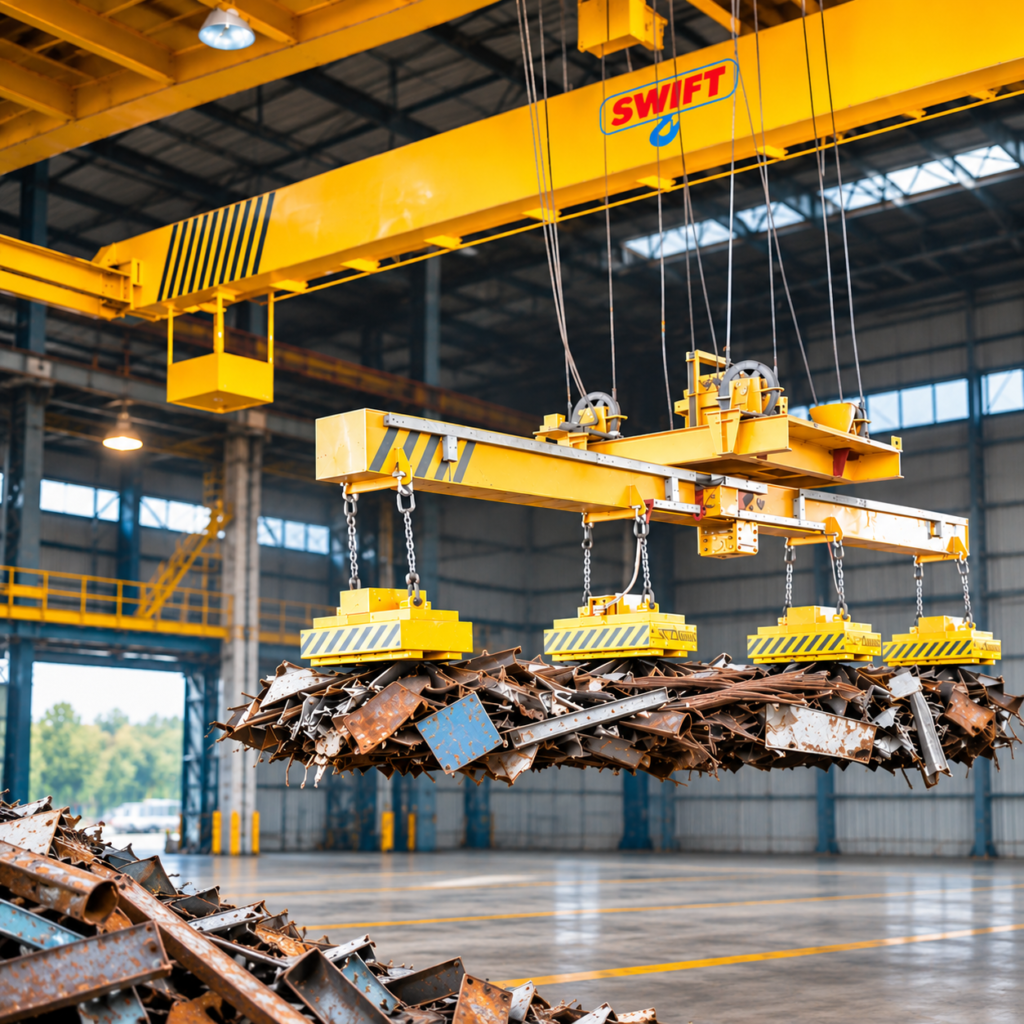
A magnet crane is an overhead crane fitted with an electromagnetic lifting device. The magnet generates a magnetic field when electrical current passes through its coil, attracting ferrous materials such as iron and many types of steel.
The basic operating process involves three stages:
- Magnet activation: Electrical power energises the electromagnet, creating a magnetic field.
- Material lifting: The magnet attracts suitable ferrous materials and holds them securely within the limits of its rated capacity and operating conditions.
- Controlled release: The operator de-energises the magnet to release the material at the designated location.
Unlike conventional lifting equipment that requires hooks, chains or slings to secure individual loads, magnetic lifting allows operators to handle suitable metal pieces directly.
This makes magnet cranes particularly useful in scrap yards, steel processing facilities, foundries and recycling plants where large quantities of ferrous materials must be moved regularly.
2. How Do Magnet Cranes Separate Different Types of Metals?
The sorting capability of a magnet crane comes from the magnetic properties of the material being handled.
In a mixed metal pile, the magnetic field attracts materials that respond sufficiently to magnetic force. Non-magnetic materials generally remain behind, allowing operators to move the magnetic fraction to a separate collection area.
Ferrous metals that can be handled
Common examples include:
- Carbon steel: Commonly found in structural components, machinery, pipes and industrial scrap.
- Cast iron: Used in machine housings, engine components and heavy industrial parts.
- Wrought iron: Found in certain structural and fabricated products.
- Magnetic stainless steel: Certain ferritic and martensitic stainless steel grades respond to magnets.
- Steel billets and ingots: Frequently handled in steel manufacturing and processing facilities.
Non-ferrous metals that generally remain behind
Materials such as aluminium, copper, brass and many other non-ferrous metals are not attracted by conventional lifting electromagnets.
This makes magnetic lifting useful for separating a bulk ferrous fraction from mixed materials before further processing.
One important exception is stainless steel. Austenitic grades such as 304 and 316 are generally weakly magnetic or effectively non-magnetic in their annealed condition, although processing can change their magnetic response. Ferritic and martensitic stainless steels are generally magnetic.
The important limitation: A magnet crane cannot reliably distinguish carbon steel from cast iron or identify the exact grade of stainless steel. It responds to magnetic properties, not chemical composition. If a facility needs to separate different steel grades or alloys, additional methods such as material testing, X-ray fluorescence (XRF) analysis or specialised automated sorting systems are required.
3. What Factors Affect the Sorting and Lifting Efficiency of Magnet Cranes?
Not every ferrous metal behaves identically under a magnetic field. Several material and operating conditions influence how effectively a crane can lift and transport a load.
A. Material composition and magnetic properties
The magnetic response of a material depends on its composition and metallurgical structure.
Carbon steel and many iron-based materials are strongly magnetic, while some stainless steel grades have significantly weaker magnetic responses.
When different materials are mixed together, the magnet may attract strongly magnetic pieces while weaker or non-magnetic components remain behind.
For recycling facilities, understanding these differences helps determine which materials can be handled magnetically and which require additional sorting.
B. Material thickness and surface area
The thickness and dimensions of the material influence how effectively magnetic flux passes through the load.
Thicker, rigid steel sections generally provide better magnetic coupling than thin, flexible sheets. Thin sheets may bend or peel away from the magnet during lifting.
For example, a solid steel billet and a thin steel plate may have the same weight but require different magnet configurations because their contact areas and structural characteristics differ.
C. Surface condition
Rust, paint, dirt, oil, oxide scale and other contaminants can create an air gap between the magnet and the material.
Even a relatively small gap can reduce magnetic lifting effectiveness.
Maintaining clean contact surfaces wherever practical helps improve the consistency and reliability of magnetic lifting operations.
D. Load shape and arrangement
Industrial scrap is rarely uniform. It may contain bent sheets, steel rods, irregular castings, metal fragments and overlapping components.
When several pieces are lifted together, magnetic flux may not reach every part of the load equally. Pieces near the outer edges may receive insufficient magnetic force and fall away.
This is why operators must consider load arrangement, magnet coverage and the possibility of loose material becoming detached.
E. Temperature of the material
Temperature is another important consideration, particularly in steel manufacturing facilities.
Ferrous materials progressively lose magnetic strength as their temperature increases. Iron loses its ferromagnetic properties near its Curie temperature, approximately 770°C.
However, a magnet’s own temperature rating and insulation limits may impose much lower operating limits. Standard magnet cranes should not be used for hot-material handling unless specifically designed and rated for the required temperature and duty.
4. How Are Magnet Cranes Used in Different Industrial Applications?
The practical value of magnet cranes becomes clearer when looking at how different industries incorporate them into daily material-handling operations.
Scrap yards and metal recycling facilities
Scrap yards frequently receive mixed metal materials from dismantled machinery, vehicles, industrial equipment and construction waste.
Magnet cranes help operators collect bulk ferrous scrap and transfer it to designated storage areas, trucks, shredders or processing equipment.
A typical workflow involves:
- Collecting ferrous materials from a mixed scrap pile.
- Lifting the magnetic fraction using an overhead magnet.
- Transporting the collected material to a designated storage or processing area.
- Releasing the material by switching off the electromagnet.
- Repeating the operation to process the remaining material.
This reduces the need to secure individual pieces manually and supports a more organised material-handling process.
Steel manufacturing plants
Steel manufacturing facilities handle heavy materials throughout production, including billets, ingots, steel sections and other semi-finished products.
Magnet cranes can transport suitable hot or cold steel products between storage areas, processing stations and production stages.
Their ability to handle multiple suitable pieces in a controlled lifting operation can help maintain material flow across busy production facilities.
Metal processing and fabrication units
In fabrication facilities, steel plates, sections and other ferrous components frequently need to be transferred between storage, cutting and machining areas.
Magnetic lifting systems can simplify the handling of compatible materials, particularly when the equipment is configured for the dimensions, thickness and weight of the products involved.
5. Magnet Cranes vs. Magnetic Separators: What Is the Difference?
Although both technologies use magnetic force, their functions are different.
Understanding this distinction is important when planning a metal recycling or material recovery system.
| Feature | Magnet Cranes | Magnetic Separators |
| Primary function | Lifting and transporting ferrous materials | Separating magnetic materials from material streams |
| Operation | Overhead crane with lifting magnet | Conveyor, drum or other separation system |
| Material handling | Bulk lifting and movement | Continuous or process-based separation |
| Typical application | Scrap yards and steel plants | Recycling and processing lines |
| Alloy identification | Not designed for alloy identification | Depends on the separation technology; conventional magnetic separators also do not identify alloy grades |
For example, a magnet crane can lift a batch of steel scrap from a mixed pile and transfer it to another location. A conveyor-based magnetic separator, on the other hand, can continuously extract magnetic material from a moving waste stream.
If a recycling facility needs to distinguish between different non-ferrous metals or identify individual alloy grades, it may require additional technologies such as eddy-current separation, optical sorting or XRF-based identification.
The correct equipment depends on the material stream and the level of separation required.
6. How Do Magnet Cranes Improve Industrial Productivity?
Magnet cranes offer several operational advantages when properly selected and integrated into an industrial facility.
Faster material handling: Magnetic lifting eliminates many of the steps associated with attaching and removing conventional lifting accessories for each suitable load.
Reduced manual handling: Operators can move bulk ferrous materials without individually securing every piece with chains or slings.
Improved material flow: Overhead movement allows scrap and steel products to be transferred between designated workstations, storage areas and processing equipment.
Better handling consistency: Properly configured magnets provide a repeatable lifting method for materials with known dimensions and magnetic properties.
Support for demanding industrial operations: Heavy-duty crane structures and appropriately selected lifting magnets can support frequent handling cycles in steel plants and recycling facilities.
These advantages depend on selecting equipment that matches the actual load characteristics, operating environment and required duty cycle.
7. What Safety Measures Are Important When Operating Magnet Cranes?
Magnetic lifting systems require careful planning because a loss of magnetic holding force can result in falling materials.
Important precautions include:
- Never exceed the rated working load limit.
- Ensure the magnet is suitable for the material type, thickness and dimensions.
- Inspect the magnet face, electrical connections and lifting components regularly.
- Avoid lifting unstable or poorly arranged scrap loads.
- Keep personnel away from the lifting and load-travel zones.
- Follow the manufacturer’s operating and maintenance instructions.
- Check battery backup and warning systems where provided.
- Use only trained operators and established lifting procedures.
A further consideration is power failure. In electrically powered lifting systems, an interruption to the power supply can affect the magnet’s ability to hold a load. Appropriate backup arrangements and emergency procedures are therefore essential.
8. What Should You Consider When Choosing Magnet Cranes?
Choosing a magnet crane requires more than simply calculating the maximum weight of the material.
The following factors should be evaluated before selecting a system:
- Material type: Identify whether the materials are carbon steel, cast iron, stainless steel or mixed ferrous scrap.
- Load dimensions: Evaluate the length, width, thickness, shape and surface condition of the materials.
- Required lifting capacity: Consider the weight of individual loads and the total weight of the material being handled in each lifting cycle.
- Crane configuration: Select an appropriate crane structure based on the required span, lifting capacity and operational requirements.
- Magnet specifications: The magnet must be suitable for the load geometry, material properties and operating temperature.
- Operating frequency: Consider the number of lifting cycles, working hours and required duty classification.
- Power backup: Evaluate backup arrangements to help manage interruptions to the primary power supply.
- Safety and maintenance: Ensure the crane and magnetic lifting system meet applicable safety requirements and can be inspected and maintained effectively.
A properly engineered system should be designed around the actual material-handling process rather than a theoretical lifting capacity alone.
9. Why Choose Consolidated Swift for Magnet Cranes?
Industrial facilities need material-handling equipment that can support their production requirements while maintaining operational reliability and safety.
Consolidated Swift Industries Limited offers magnet crane solutions designed for lifting ferrous materials in applications such as steel billet handling and metal recycling.
Its magnet cranes feature:
- Double Girder (DG) configuration for higher load-handling requirements.
- Magnet battery backup to support magnet operation during power interruptions.
- Customised lifting capacity and span according to customer requirements.
- Compliance with applicable IS standards for construction and safety.
These features make the equipment relevant to industrial facilities that require dependable magnetic lifting solutions for regular material-handling operations.
Businesses planning a new installation or upgrading an existing material-handling system can review the Consolidated Swift Magnet Crane solutions to understand the available options.
Final Thoughts on Magnet Crane Efficiency
Magnet cranes make ferrous material handling more efficient by using electromagnetic force to lift, transport and release suitable iron and steel products. They are particularly useful in scrap yards, steel manufacturing plants and metal processing facilities where bulk materials must be moved regularly.
Their effectiveness depends on more than magnetic strength alone. Material composition, thickness, surface condition, load geometry, temperature and operating procedures all influence lifting performance.
It is equally important to understand that magnet cranes separate magnetic materials from non-magnetic materials rather than identifying individual steel grades. Facilities requiring more precise material classification should combine magnetic lifting with suitable testing and sorting technologies.
With the right crane configuration, lifting magnet and safety arrangements, magnet cranes can support smoother material flow and more organised industrial operations.
Looking for a magnet crane for your industrial application? Contact Consolidated Swift Industries Limited to discuss your lifting capacity, material type and operational requirements.